Judicial and Administrative Arrest Warrants
This analysis examines Fourth Amendment protections and arrest warrants to assist readers in evaluating current events.


Note: Before reading further, read part one here. This is the latest in our review of legal processes used by the government.
In the last analysis, we looked at search warrants. In this analysis, we will turn to arrest warrants. Protections regarding arrest warrants, like search warrants, are afforded by the Fourth Amendment:
“The right of the people to be secure in their persons, houses, papers, and effects, against unreasonable searches and seizures, shall not be violated, and no Warrants shall issue, but upon probable cause, supported by Oath or affirmation, and particularly describing the place to be searched, and the persons or things to be seized.”
The standard for arrests is probable cause because an arrest constitutes a seizure under the Fourth Amendment.
Judicial Arrest Warrants
At the federal level, arrest warrants are often secured through a grand jury indictment. The government presents facts to a grand jury to establish probable cause that the stated federal offense was committed by the named individual. If the grand jury agrees, they return a “true bill,” formally charging the individual.
Then, an arrest warrant is prepared and signed by the clerk of court. Arrest warrants issued following criminal complaints are signed by a judge. These are all judicial arrest warrants, though the word “judicial” is not always stated.
Here is where things get interesting at the intersection of arrest warrants and searches.
Hypothetical scenario:
Federal agents with a judicial arrest warrant arrive at a residence, knock on the door, identify themselves, and command the individual named on the warrant to exit the residence. The agents know the individual lives there and is present, but there is no movement or response from inside.
Can the agents go in without consent?
The Fourth Amendment protects individuals from the government entering their homes for unreasonable searches, but what about entering their homes to arrest them? Is this considered “searching” for the individual?
Hypothetical scenario, continued:
The courts have upheld the following parameters. A judicial arrest warrant “carries with it limited authority to enter a dwelling in which the suspect lives when there is reason to believe the suspect is within.” Therefore, in this scenario, it is lawful for the agents to force entry into the residence to execute the arrest.
If the person is at a third-party residence, then agents must obtain a search warrant for that residence to execute the arrest warrant. To force entry would violate the third-party’s Fourth Amendment rights.
[Note: This was a simplistic scenario for demonstration. There are other factors that might need to be considered during an arrest scenario.]
Administrative Arrest Warrants
For the Department of Homeland Security (DHS), including Immigration and Customs Enforcement (ICE), they have something called an administrative arrest warrant. Like their administrative subpoenas, these lack judicial review. These are prepared on internal forms, Form I-200 and Form I-205, and are signed by an immigration official. Unlike with administrative subpoenas, no other law enforcement agency has this unilateral arrest warrant power.
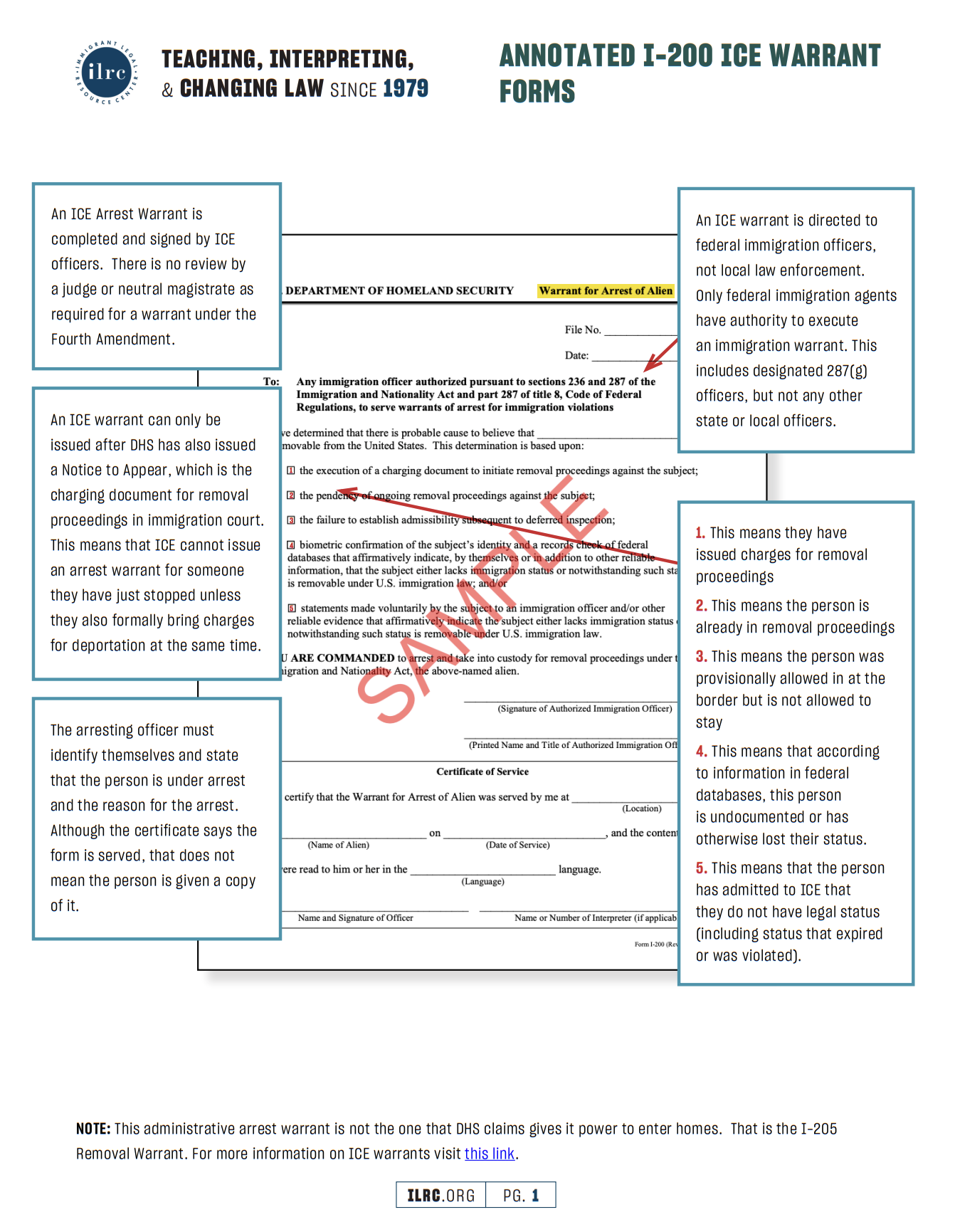
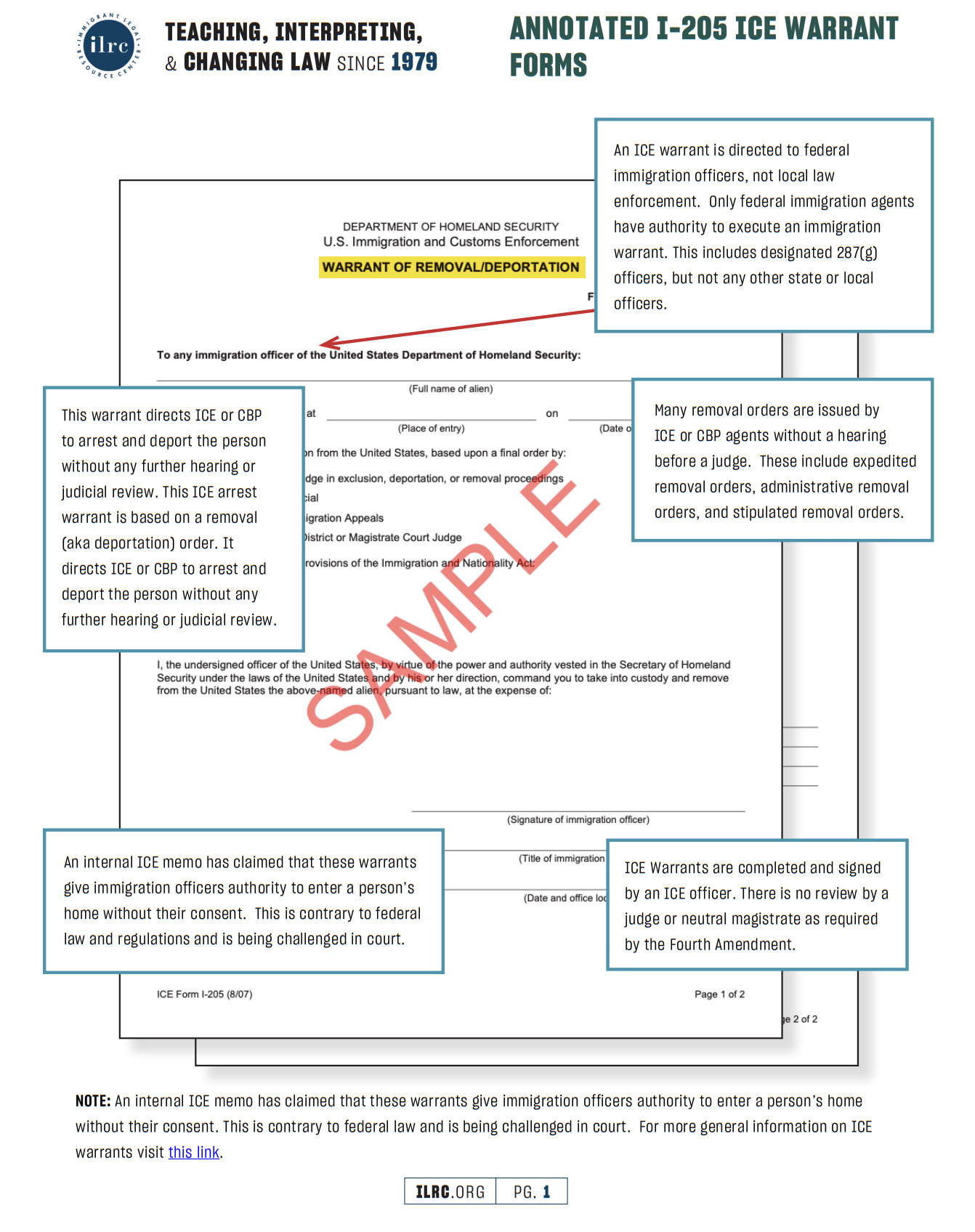
Because these lack judicial review, administrative arrest warrants, historically, have not given ICE agents authorization to enter residences without consent of the resident or other legal authority. Under specific regional boundaries in California, immigration agents may not enter the curtilage of a home to arrest an occupant with an administrative arrest warrant without consent or or other legal authority.
This was standard legal training provided to ICE agents and those who were assisting ICE.
In January 2026 during operation PARRIS in Minneapolis, news media stories were trending with titles such as “ICE officers assert sweeping power to enter homes without a judge’s warrant, memo says.”
Anyone with background knowledge of administrative arrest warrants could have concluded these stories were mistaken. Legal training on administrative arrest warrants was explicitly clear. But these stories were confirmed as true, and justifications surfaced.
According to a whistleblower complaint, ICE circulated a memo authorizing the use of administrative arrest warrants to enter residences forcefully with Form I-205. The complaint also alleged that the memo was not formally distributed to all personnel, but only to select DHS officials. It was verbally communicated to others, even while training materials said otherwise.
DHS has claimed, among other things, that since Form I-205 is prepared after an immigration judge has given an order of removal, these administrative warrants are equivalent to judicial arrest warrants that authorize forceful entry.
Legal analysis has shown why these justifications are problematic. For example, immigration judges are part of the executive branch; they are not “neutral and detached” magistrates under the judicial branch. Payton v. New York (1980) established this standard to authorize forceful entry with a judicial arrest warrant.
You can read Just Security’s response to an op-ed by DHS’s legal counsel to learn more (and please do!)
Recourse and Reactions
In January 2026, a federal judge in Minnesota ruled that ICE’s new approach violates the Fourth Amendment and ordered the release of the individual arrested.
Members of Congress have demanded that ICE rescind the memo.
On April 2, 2026, Protect Democracy, the ACLU, the ACLU of Minnesota, the ACLU of D.C., and Dorsey & Whitney filed suit against DHS and ICE concerning these practices. One plaintiff alleges ICE forcefully entered the residence with an administrative arrest warrant for a family member that did not live there nor was present. This is not even lawful with only a judicial arrest warrant as discussed earlier concerning third-party residences.
The organization Lawfare is maintaining a tracker for tracking government non-compliance in habeas corpus cases.
Judicial Implications
As federal law enforcement agencies partake in actions that erode public confidence and the presumption of regularity with the court, the effects are showing.
Grand juries again and again have rejected indictments by the federal government. These have traditionally been easy to secure, as the saying goes, “You can indict a ham sandwich.”
Judges have scolded the DOJ after viewing grand jury transcripts.
Judges are rejecting search warrants, citing lack of probable cause.
Judges are questioning the intentions of law enforcement within the wording of search warrant affidavits, whereas the language had been standard language. If judges lose confidence that the government is acting in good faith, even standard language can become suspected of ill intent. This will have tremendous effects on law enforcement who are acting in good faith which affects the security of us all.
What Can You Do?
One: Share information like this with others. Democracy depends on public awareness and civic engagement.
Two: Grow your own understanding of your privacy rights and a basic understanding of what it looks like for law enforcement to be acting in good faith.
Three: Consider supporting our work as we aspire to democratize and share this type of intelligence.