By the Numbers: The Quiet Collapse of Justice
A former FBI analyst picks apart OPM’s data to tell a deeper story of who has left the department and why.


This article was originally published on April 7, 2026, for Justice Connection. As a former FBI intelligence analyst, Philip Fields analyzed OPM’s data which tells a deeper story of who has left the department and why.
Earlier this year, a Justice Department attorney filed a motion requesting an extension in the Fifth Circuit Court of Appeals that deserved attention.
The attorney is an Assistant Director in DOJ’s Civil Division, a component that has lost over 40% of its attorneys since February 2025. She told the court that she needed more time because the lead attorney assigned to the case left, and the next one she assigned went on extended leave. With the diminished staff, she couldn’t reassign it to another attorney and had to take it on herself. In that request, she openly admitted she couldn’t devote her full attention to the case and listed nine other pending cases requiring her immediate attention, in addition to her extensive managerial duties.
This is not a normal occurrence at DOJ, or it hasn’t always been. According to data available from the Office of Personnel Management, DOJ had 12,955 attorneys as of December 31, 2024. Approximately 3,402 attorneys left their roles between January 2025 and January 2026 (I’ll refer to this timeframe as 2025 for brevity).
Let that sink in.
DOJ lost over a quarter of its legal machinery in a year dominated by an administration that prides itself on a “law and order” mantra.
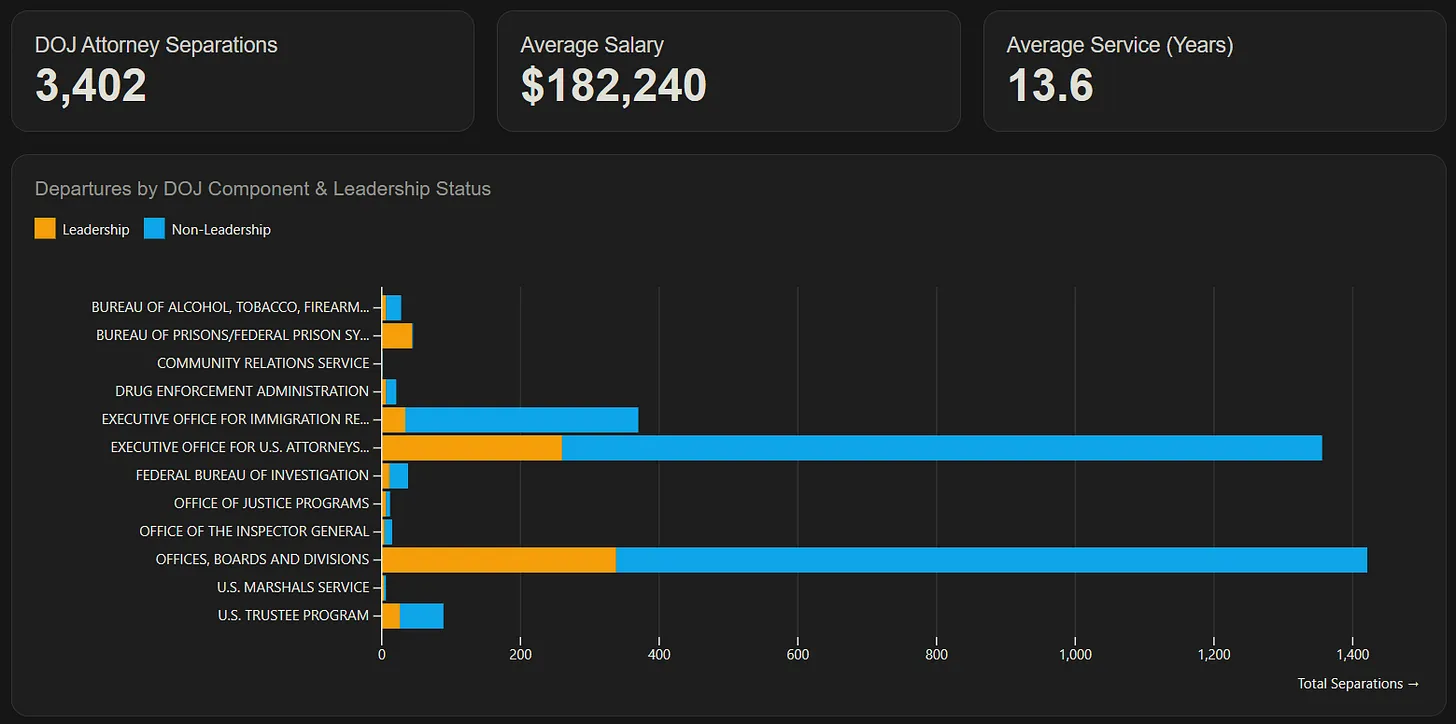
The vast majority of those attorneys worked at DOJ headquarters or the U.S. Attorneys’ offices. Most of them resigned, which is why we continue to hear stories of attorneys like this Civil Division attorney juggling the responsibility of three or more roles just to find time to file motions requesting more time. It’s not just the lawyers living on borrowed time. This trend rippled across DOJ and throughout the wider federal workforce.
In March 2025, I joined the exodus when I resigned from the FBI after more than 13 years as an intelligence analyst. A few months later, my spouse resigned as an FBI analyst as well. On October 1, 2025, we launched the Forking Off podcast, featuring interviews with former federal employees from across government, including several DOJ alums. We spent the next four months telling a new story every week. In February 2026, we decided to scale back to one episode a month and allow time to focus on getting our new business up and running.
Somewhere along the way, I noticed discussions about the federal workforce focused narrowly on whichever class of employees was relevant to the current news cycle. So, when I read about the loss of 300 FBI agents who worked mostly on national security matters, I decided to try to contribute in a data-driven way that could tell a broader picture and complement our oral storytelling efforts.
Thankfully, my time as an FBI intelligence analyst prepared me well for projects like this. I wanted to build something approachable that would enable anyone to dig for the stories they cared about, ideally without hosting costly web servers. I recalled a project from a past life where we had to condense large datasets into small, portable files users could work with in the field. With a little creativity, I managed to get OPM’s 1GB dataset into a user’s browser in under 15MB. The initial load takes a few seconds longer than an average webpage, but once it’s there the rest is pretty snappy. That’s where the fun starts!
I’m calling this project Separation Anxiety to reflect that feeling we all get when thinking about what we’ve lost.
The Dataset
Once I dove into the data, I came across some staggering statistics.

The average length of service for a DOJ employee who left during 2025 was 16.6 years. The average departing leader had more than 22 years of federal service. This brings us back to our earlier story at the Fifth Circuit. Among the 3,402 attorneys who left DOJ in 2025, 738 of them were serving in leadership roles. DOJ headquarters lost 1,421 attorneys, including 338 in leadership roles. The United States Attorneys’ Offices lost an additional 1,356 attorneys, including 260 leaders.
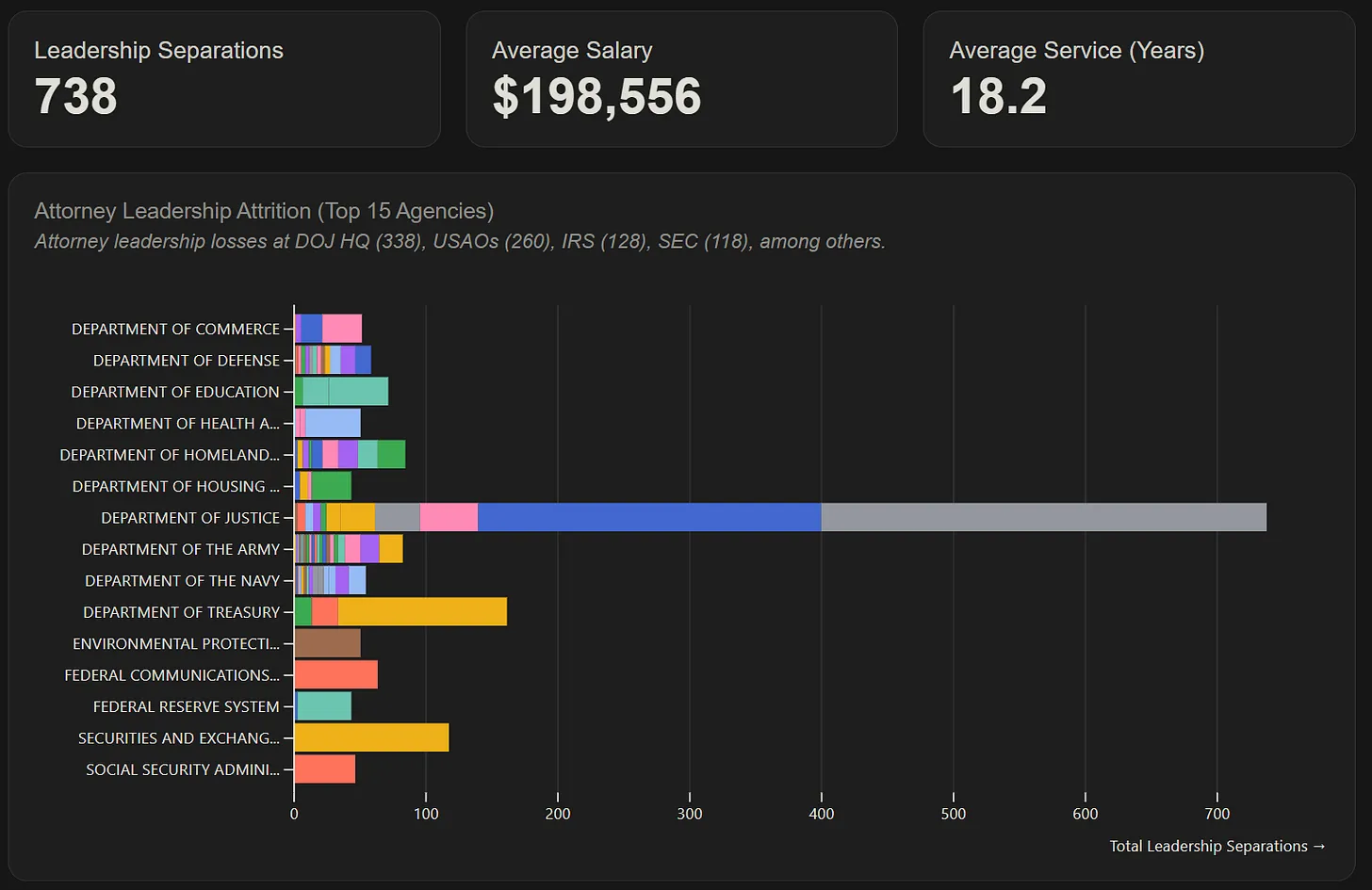
Of the departing attorneys, 2,069 resigned prior to retirement eligibility, meaning many did not have an alternate source of income. These were civil servants faced with such abject disillusionment they had no alternative but to walk away from their passion.
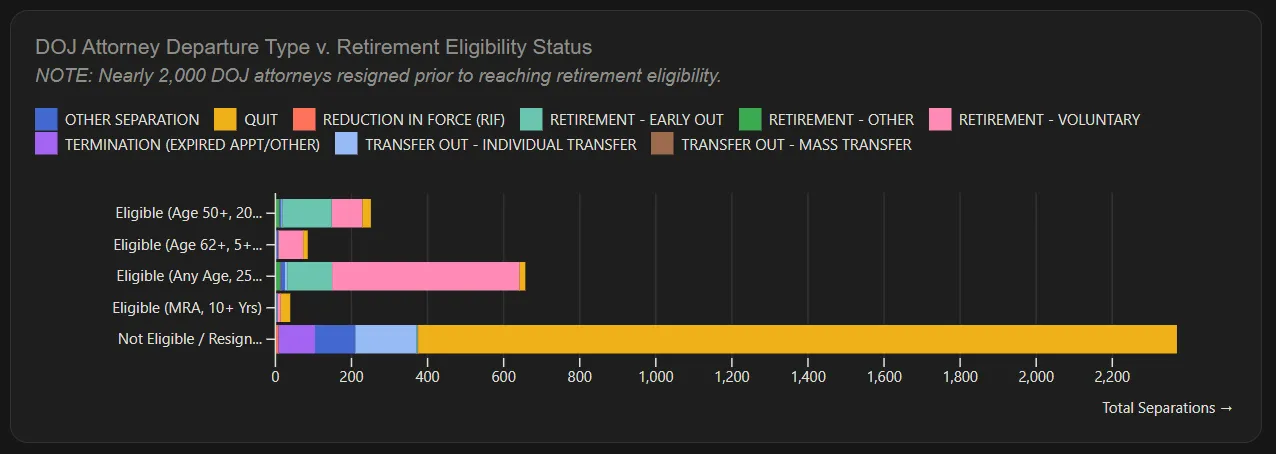
Another 370 attorneys left their roles at the Executive Office for Immigration Review – mostly immigration judges – including 34 leaders (this includes the more than 100 immigration judges who were fired). These numbers may feel small in comparison to some of the larger components, but this is an agency that had 735 immigration judges in FY24.
The Bureau of Prisons & The FBI: Devastating Losses
When looking at DOJ departures, there was another story screaming to be seen. The Bureau of Prisons lost 4,512 employees in 2025, including 1,228 leaders with over 20 years of service on average. The largest number of departures were resigning correctional officers.
There was also a substantial number of highly paid and experienced medical professionals, which is especially concerning given the already challenging environment within the federal prison system.
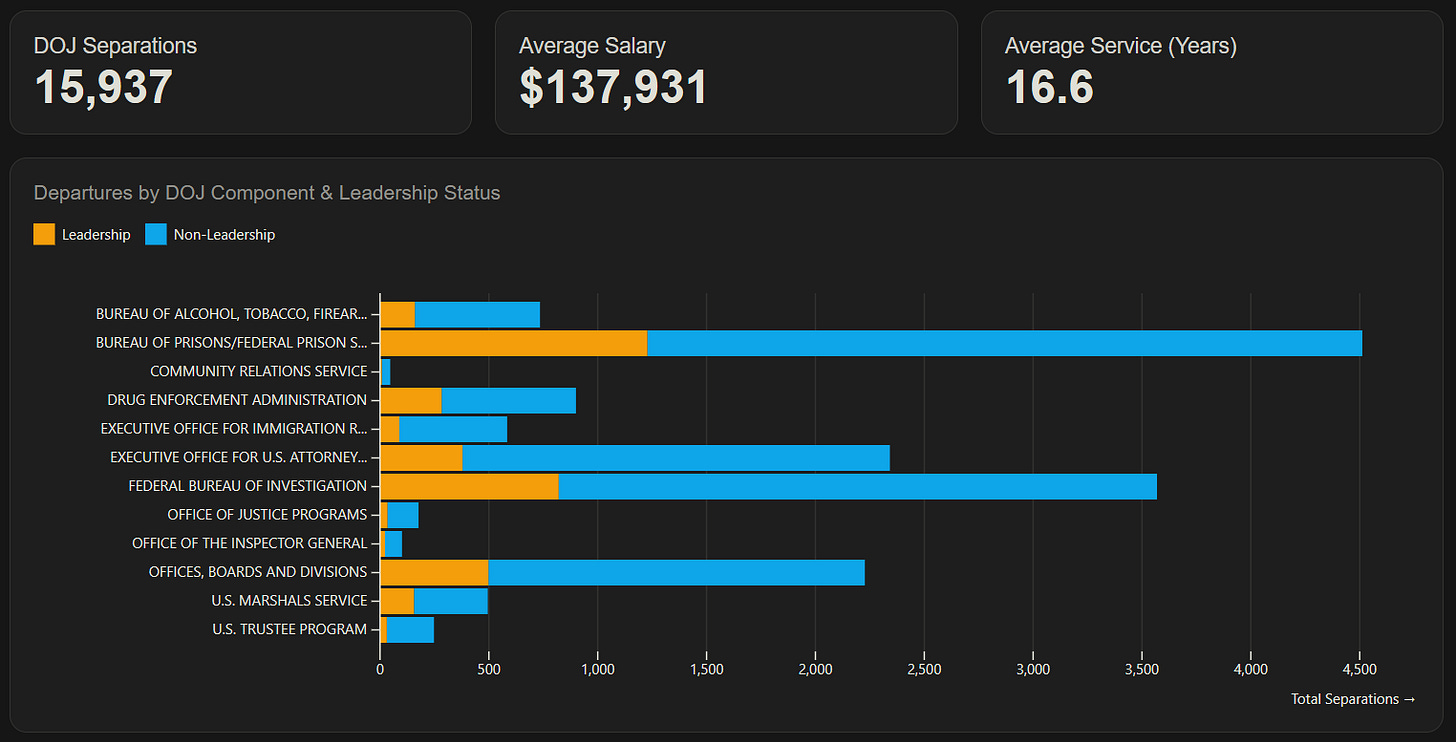
Regarding the 300 FBI special agents who worked mostly on national security matters, that is a staggering number to be sure, but it’s just a small piece of the story.
The FBI lost 1,139 special agents overall, with an average tenure of 21.8 years during 2025. That included 407 leaders, 65 of whom were serving in the Senior Executive Service. The weight of that loss has yet to fully come down, but it will eventually fall.
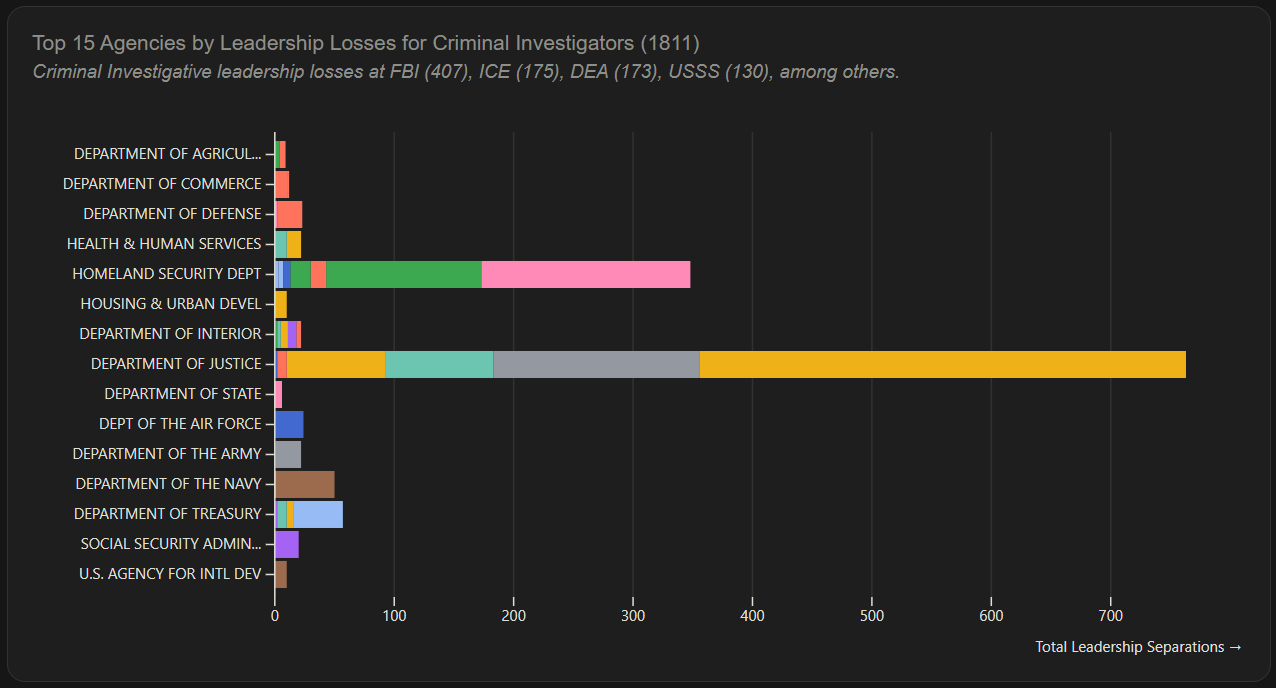
According to numerous direct and indirect sources I’ve spoken with over the last several months, the FBI has lost so many senior leaders that it no longer has qualified applicants to fill special agent vacancies in the Senior Executive Service or at the GS-15 grade level. This was unthinkable even a year ago. The FBI isn’t the only DOJ component with special agents – ATF and DEA rely on them too. Across DOJ, 1,999 special agents left during 2025, including 763 leaders with an average 25 years of service. America is less safe as a result.
In the years following 9/11, the FBI grew its intelligence capacity in directions that I’ve yet to see replicated. The integration of intelligence into the Bureau’s operations was its strength. It drove our success and positioned us as a leader in the fight against the Islamic State. For every five to ten FBI special agents there is often an intelligence analyst guiding them in their quest as they sift through a pile of needles looking for that one especially dangerous needle.
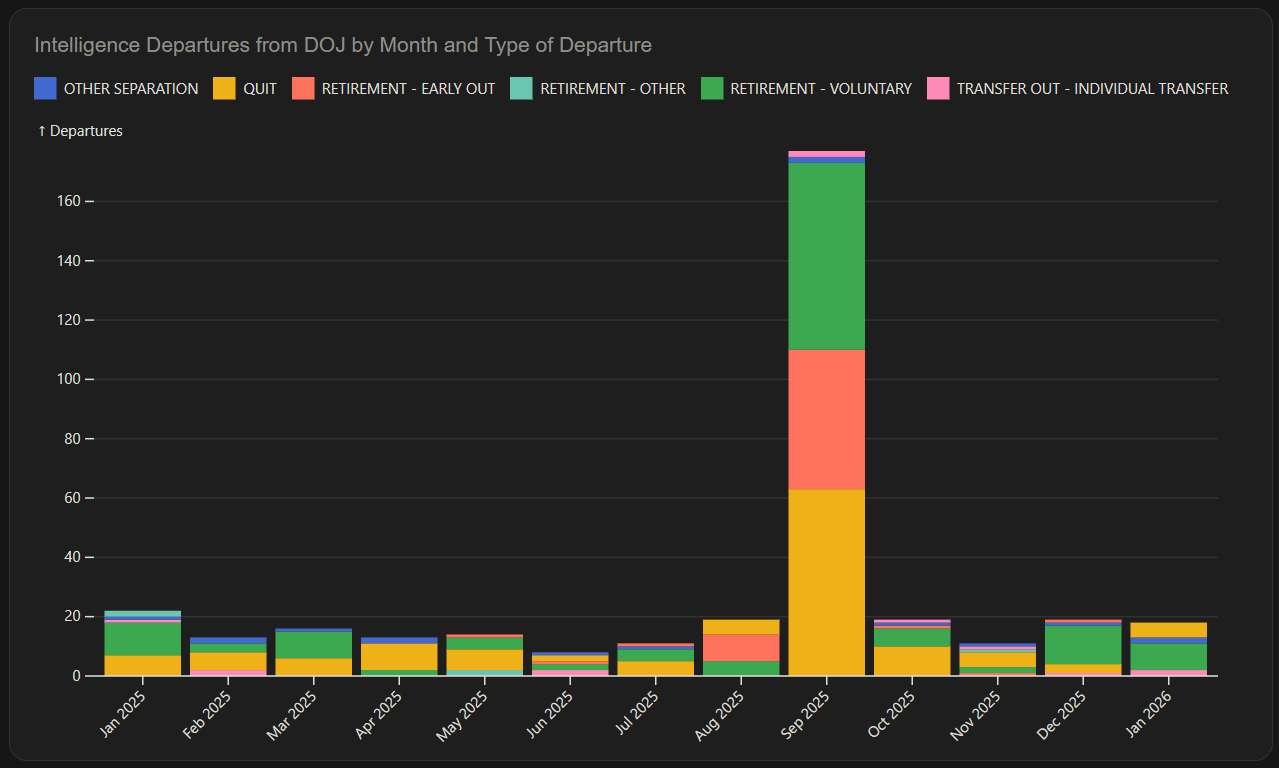
In 2025, 232 intelligence analysts left the FBI with an average of 19.6 years of federal service. Sixty-six intelligence leaders, including 11 Senior Executives, departed. An additional 128 intelligence analysts and 31 leaders left DOJ. These were the largest publicly reported intelligence losses across the federal government. The largest comparable losses were at the Air National Guard Units (188), US Army INSCOM (180), DHS (144), and the Air Force Air Combat Command (88).
More to Come
This is just a snapshot of the information I’ve found so far.
And I haven’t even mentioned some of the interesting little things I’ve found along the way. For example, while trying to correct an issue where OPM reported that some employees had between 125 and 1,826 years of public service, I came across a record for Maria Bandouveres, who passed away peacefully at age 98 after 81 years of federal service. Maria began her career as a typist in 1944.
While it will likely take years to fully comprehend what we lost in 2025, I hope this project will enable the public to engage more productively with the data and hasten the path to insight. The full code is available on GitHub, and I’d love to hear from users with ideas to improve the effort.
As the project continues to develop, I hope it serves as a powerful testament to the critical capacity we’ve lost in keeping Americans safe, and what we must ultimately strive to rebuild.

Justice Connection is a network of DOJ alumni who are standing up for the rule of law and protecting our former colleagues who’ve been targeted by this administration.